

And thus, Agentic Engineering was born
At some point, it stopped looking like interest in a technology category and started looking like interest in an engineering discipline
For the past few years, the AI conversation has revolved around models. Every breakthrough seemed to raise the same questions about which model is better, which benchmark improved, or which company released the latest capability?
Those questions still matter as foundation models remain the foundation of everything happening in AI today. But it feels like the centre of gravity has shifted (slightly at first and then all at once).
The work happening today isn’t about making a model better at answering questions. It’s about figuring out how to build systems around those models that can reason, retrieve information, use tools, coordinate actions, and operate live workflows.
We had our own theories about where the AI conversation was heading, but theories are cheap. If Agentic Engineering was going to be built around the questions people actually care about, there was only one group worth asking.
So we turned to the people reading this
A few weeks ago, we asked you what you wanted more of from AI coverage. While the responses covered a wide range of interests, the overall message was consistent (and I’m not surprised).
You weren’t asking for more AI news.
You weren’t asking for more model rankings.
And you certainly weren’t asking for more hype.
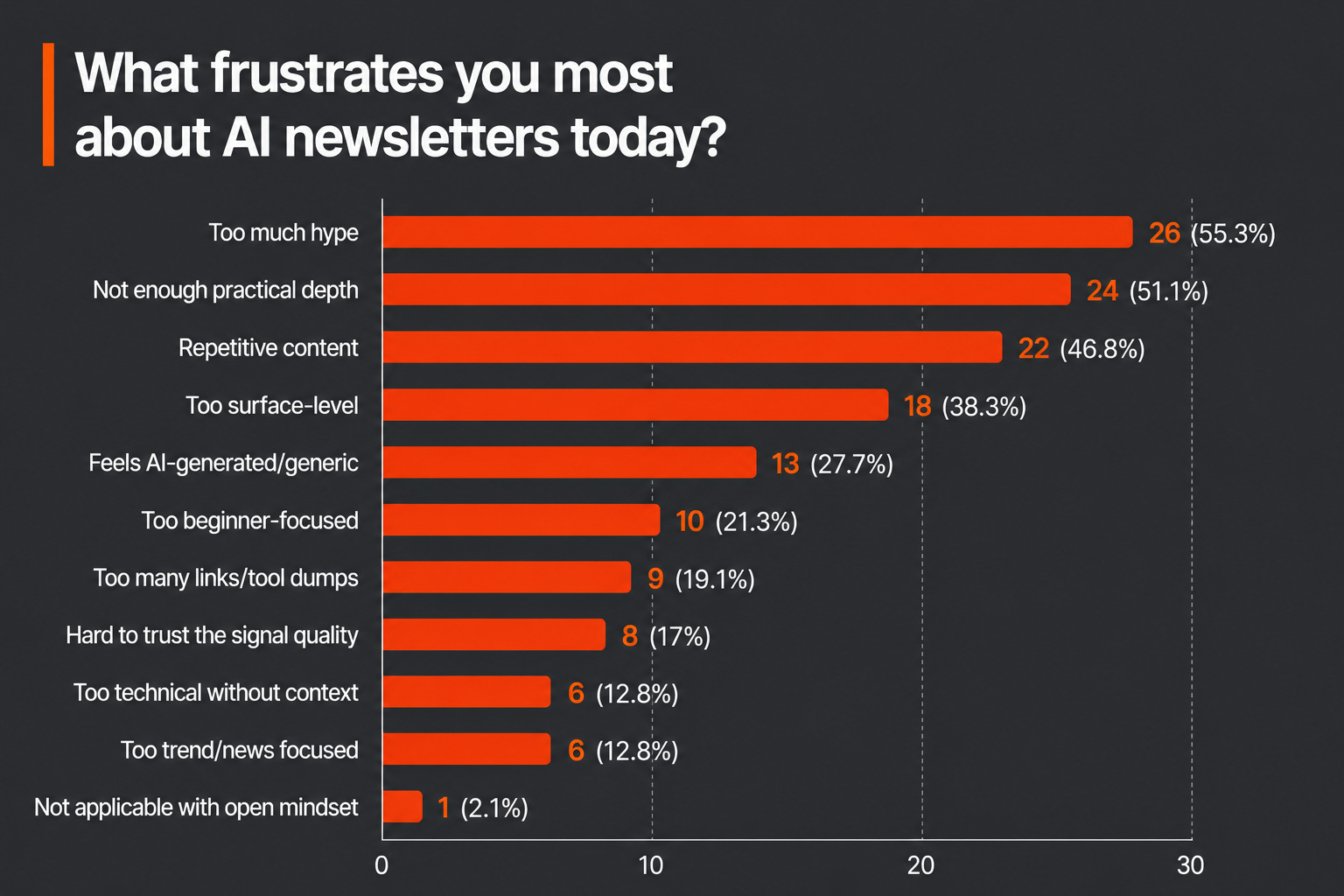
The most common frustrations with AI newsletters today were too much hype, a lack of practical depth, and repetitive coverage that often feels disconnected from how AI is actually being used. What you wanted instead was real-world workflows, implementation advice, clear explanations of complex topics, and lessons from teams building with these technologies in practice.
The interesting part wasn’t that AI agents ranked first. Honestly, I expected that.
What caught my attention was everything sitting underneath it.
Open-source AI. Infrastructure. RAG systems. Multi-agent systems. Agent orchestration. Evaluation.
At some point, it stopped looking like interest in a technology category and started looking like interest in an engineering discipline.
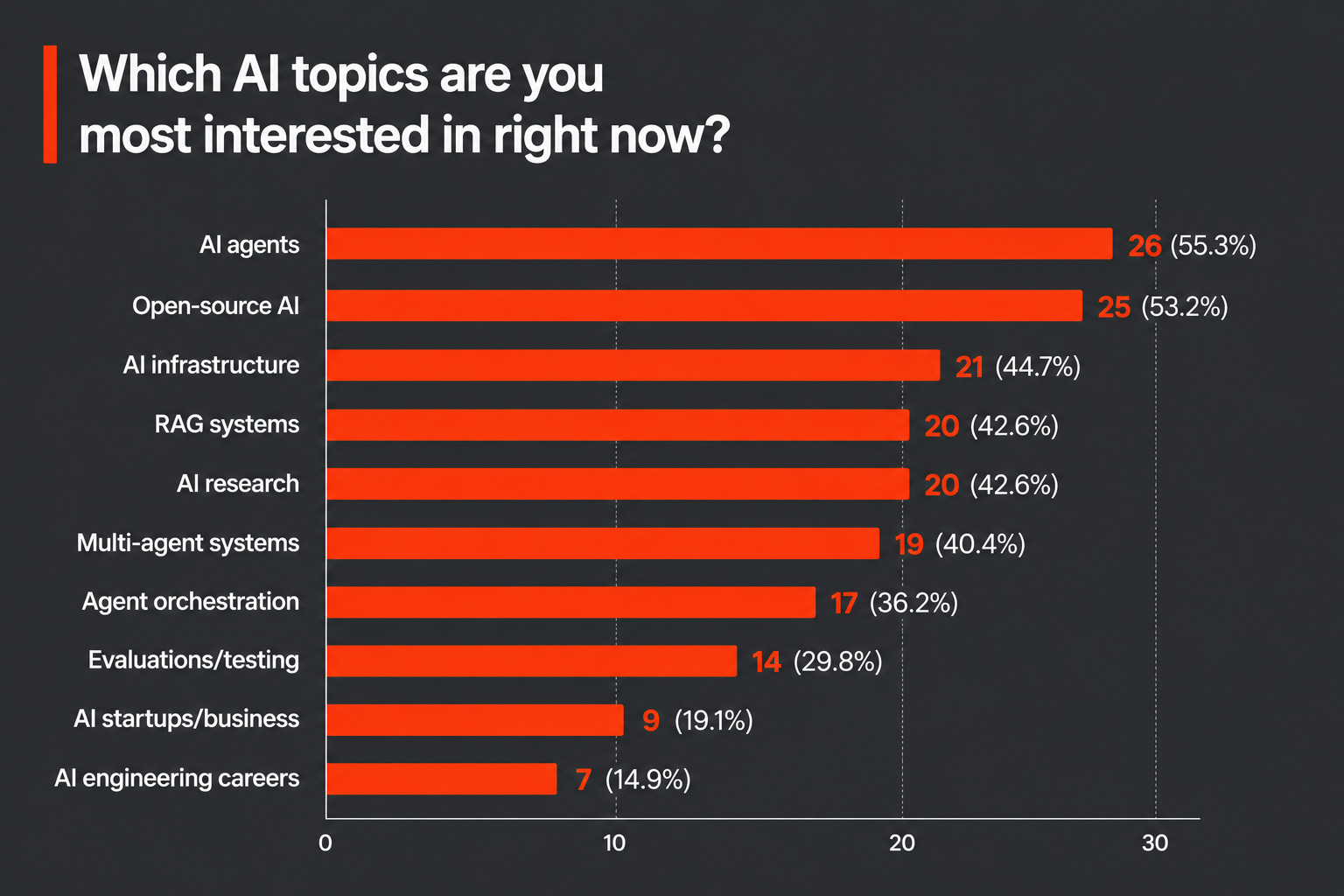
Taken together, those responses point toward something bigger than a content preference. They point toward a shift in the conversation itself.
Once AI systems begin interacting with databases, applications, workflows, enterprise systems, and even other agents, an entirely new set of questions emerges.
How should these systems be evaluated?
How do you observe and debug them?
What does governance look like when AI can take actions rather than generate outputs?
How much autonomy is too much?
How do you move from an impressive demo to something people can actually trust?
These aren’t purely research questions. They’re engineering questions that sit at the intersection of software engineering, AI engineering, operations, product design, governance, and systems thinking.
That’s why Agentic Engineering was born
Not because every workflow needs an agent. Not because every company should rush to deploy autonomous systems. And certainly not because we’re interested in chasing the latest buzzword.
Agentic Engineering exists because a distinct engineering discipline is beginning to emerge around how these systems are designed, evaluated, deployed, governed, and integrated into real-world environments.
Where we go from here
Over the coming months, we’ll be exploring that discipline through expert-written analysis, interviews with practitioners working close to the technology, research breakdowns, case studies, and conversations with the people building these systems every day.
The truth is that nobody has all the answers yet. The playbook for building reliable agentic systems is still being written. Best practices are emerging in real time. Some ideas will prove durable. Others won’t survive contact with production.
We’re watching a new engineering discipline take shape, and we’d like to document it as honestly as possible. The breakthroughs, the lessons, the contradictions, the failures, and the things that genuinely move the field forward.
If you’re trying to make sense of where agentic systems go from here, you’re in the right place 🙂
Fantastic read, thanks Tanya. Very much looking forward to seeing where Agentic Engineering takes us.