

The spectrum of today's agents
How systems evolve from retrieval and task execution toward operational autonomy
The current AI ecosystem has developed a habit of describing wildly different systems with the exact same word: agents. A retrieval pipeline that reformulates search queries, a workflow assistant that schedules meetings, and a system capable of coordinating multi-step operational decisions with minimal supervision now all routinely get discussed under the same umbrella.
And I think that’s why the conversation around agents sometimes feels simultaneously overcomplicated and vague. In reality, though, these systems are operating at very different levels of autonomy.
So, after spending the last few articles looking at how agents are structured and orchestrated beneath the surface, I wanted to take a new angle: the different kinds of agents organizations are building, and how capabilities change as systems move from retrieval into action and eventually toward autonomy.
For builders navigating the move from models to agents
Looking at agents through this lens, the differences between these systems start becoming much easier to spot.
Some are primarily designed to retrieve and synthesize information more intelligently. Others are built around executing workflows and operational tasks. And some are beginning to operate with much higher levels of autonomy, coordinating decisions and adapting dynamically as conditions change.
Broadly speaking, most AI agents today fall into three categories: retrieval agents, task agents, and autonomous agents.
Retrieval agents
Retrieval AI agents build upon the foundations of RAG but incorporate advanced agentic behaviors, making them more autonomous and adaptive. In fact, we are adding to a standard RAG pipeline an additional layer of intelligence and planning that allows the agent to “strategize” on how to retrieve the most relevant pieces of information.
Retrieval AI agents are often referred to as agentic RAG. With this approach, knowledge sources are treated as “tools,” meaning that they will come with a description in natural language so that the agent can decide which source to invoke depending on the user’s query. Once the source is invoked, the retrieval mechanism follows the same pattern as traditional RAG, yet we will have this additional layer of intelligence that can decide whether it is enough to answer or not, and if necessary, invoke further sources.
Let’s consider the following example.
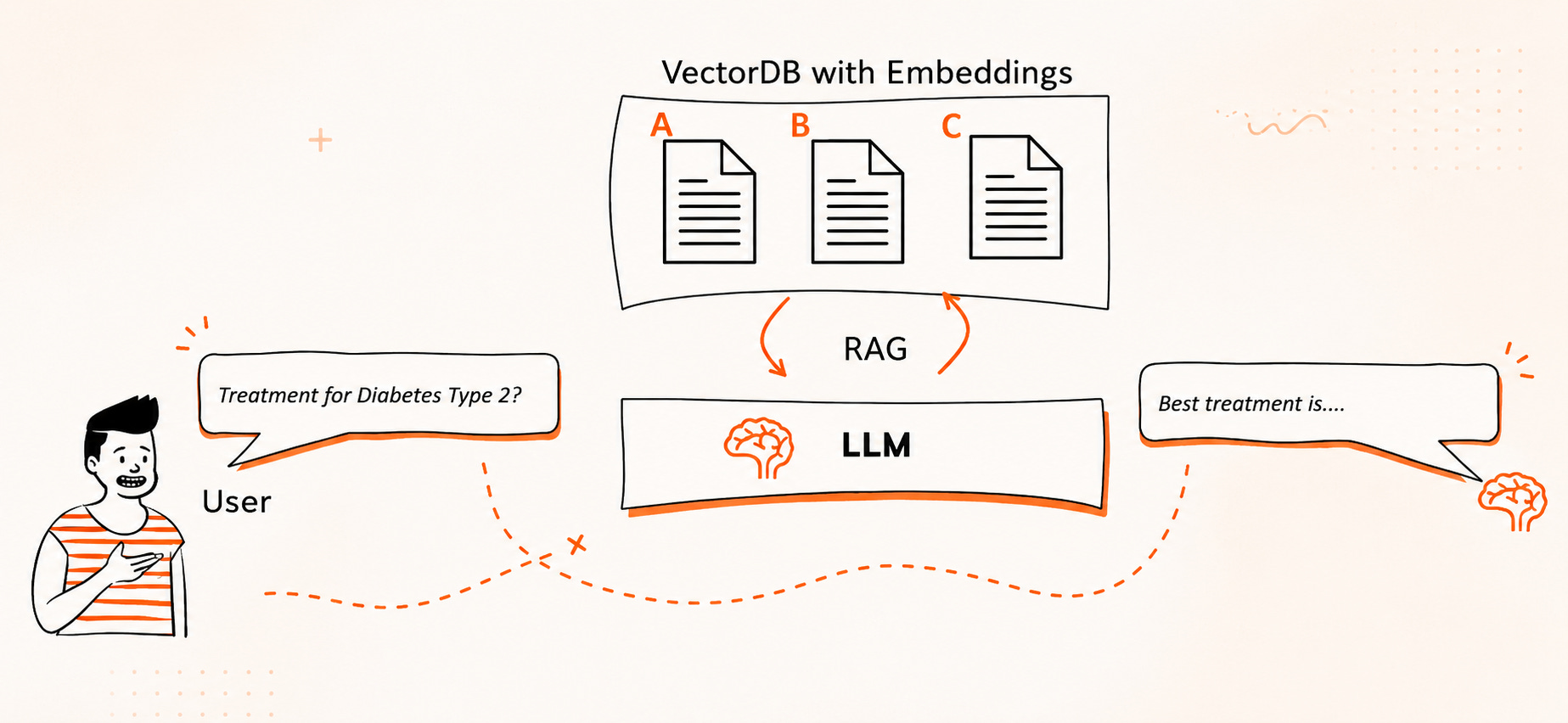
Let’s say we want to build an AI assistant for a doctor to quickly retrieve information about treatments. Given the doctor asks: “What are the latest treatments for Type 2 diabetes?”, let’s see how the two approaches compare:
Traditional RAG approach:
The RAG system retrieves the top three relevant articles from the database.
The model extracts relevant text from those articles and generates a response summarizing key treatments.
If the retrieved documents do not fully answer the doctor’s question, the model cannot refine the search unless the doctor manually submits a new query.
Retrieval AI agent approach
The agent retrieves an initial set of documents and analyzes them.
It detects that some retrieved studies are outdated, so it refines its search criteria and retrieves more recent publications.
It recognizes a gap in information regarding a specific drug and fetches a dedicated study on that drug.
Finally, it synthesizes all retrieved sources into a comprehensive answer, ensuring relevance and completeness.
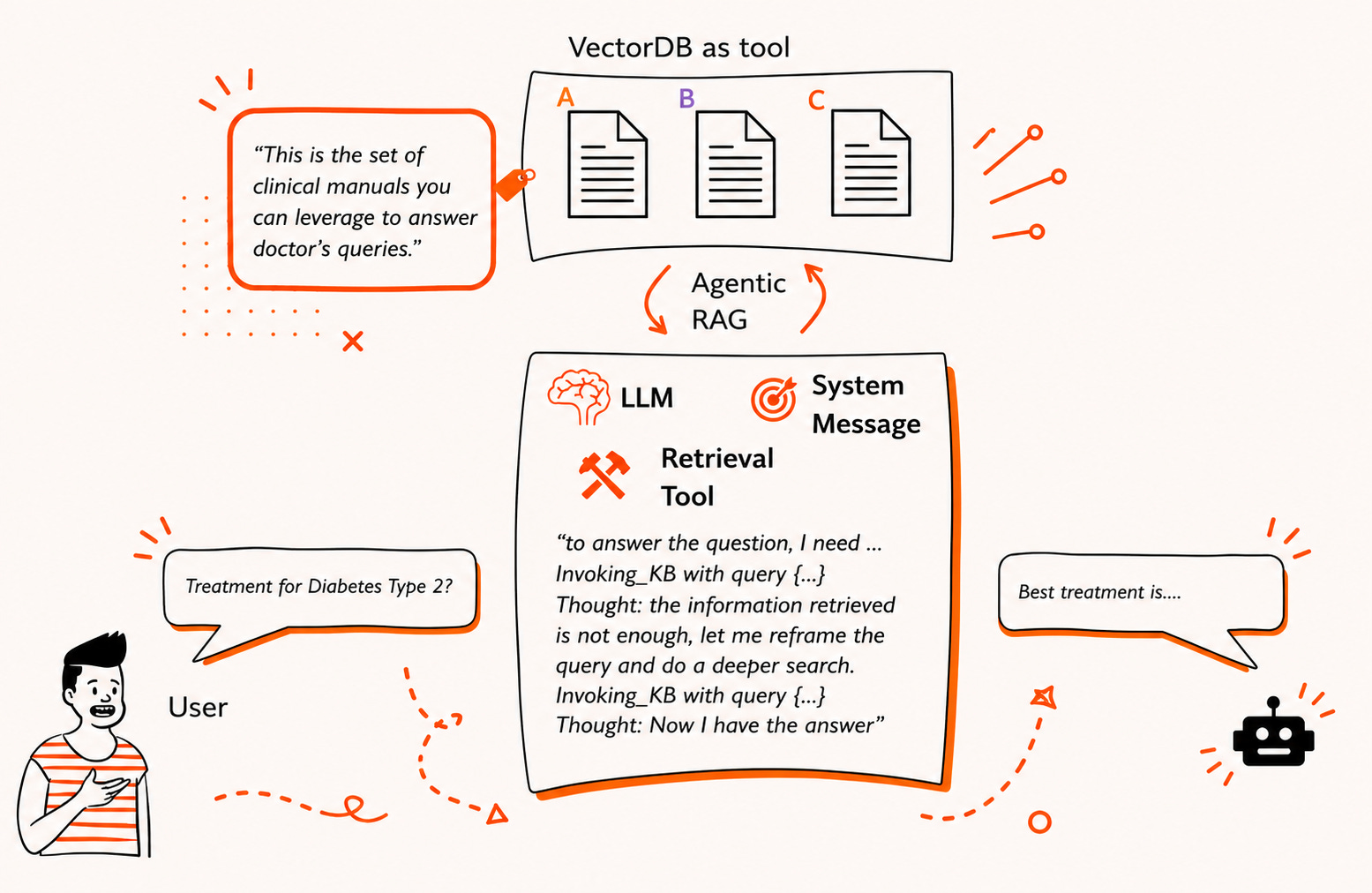
In conclusion, agentic RAG can lead to several improvements over traditional RAG. Unlike traditional RAG systems that typically rely on a single retrieval pass, retrieval AI agents can iteratively refine their searches by breaking complex queries into multiple steps and progressively improving the relevance of the information they gather. They also maintain contextual awareness through memory of previous interactions, allowing them to ask clarifying questions, adjust retrieval strategies dynamically, and respond more intelligently over time.
Another important difference is their ability to interact directly with tools such as APIs, databases, and vector search engines, enabling them to fetch structured and real-time information when needed. Rather than pulling information from a single static source, retrieval agents can also augment knowledge adaptively by combining and synthesizing information across multiple sources depending on the context of the query. In many cases, these systems can even make autonomous decisions about when additional retrieval is necessary, which sources are most relevant, and how search results should be refined to improve the overall quality of the response.
Retrieval agents are the simplest form of AI agents, yet the extra layer of intelligence is already demonstrating great improvements for the overall user experience. However, the real power of an AI agent comes to life when it can combine retrieval skills with actionable tasks.
Task agents
Task agents go beyond information retrieval by performing specific actions. These agents are designed to automate workflows and replace repetitive tasks for users. Unlike retrieval agents, they execute predefined actions in response to user commands or external triggers.
When talking about AI agents, you will often hear the terms tasks, tools, skills, plugins, functions, and actions as interchangeable ways to refer to the agent’s capabilities of doing things. You will also see that different AI orchestrators come with different terminology. Let’s try to get some clarity:
Tasks define what needs to be accomplished and can range from simple actions, like sending an email, to complex processes involving multiple actions.
Tools provide external means to perform tasks, like a data visualization tool to create charts or a language translation service to interpret text in different languages.
Plugins extend functionality through integration with other platforms, and they typically come with a set of operations or functions that can be executed against that platform (list rows, append new record…).
Functions outline internal methods of operation – for example, a get_weather function, properly defined, will be able to return the current weather in a given location.
Skills represent the agent’s learned proficiencies and are typically defined in a declarative way (natural language). You can think about skills as “mini-prompts” that are invoked only in cases where that specific skill is needed.
Actions are the concrete steps or operations that an AI agent takes in response to a given situation or input. They are the real-time manifestations of an agent’s functions and skills, leading to observable outcomes.
Let’s consider once again an example in the healthcare domain, this time from the perspective of the general practitioner’s office receptionist, John.
John manages a high volume of appointment requests. Patients book visits through various channels: phone calls, emails, and an online booking system. Managing last-minute cancellations and rescheduling requests is time-consuming and often leads to gaps in the schedule.
A typical process in John’s day might look like the following:
John receives an email from Patient X to book an appointment and shares some preferences in terms of date and time
John checks the availability of the specialist practitioner required and tries to match the earliest slot possible with Patient X’s preferences
John doesn’t find any match, hence goes back to Patient X to find alternatives
Finally, John and Patient X agree on a slot and the appointment is scheduled
If you think about the above steps, they are nothing but tasks that John is meant to perform to achieve the goal – scheduling the appointment in an optimized slot for both the practitioner and the patient.
Whenever we want to map and enhance a business process with an AI agent – more specifically, a task agent – a good practice is that of transposing the human tasks into agentic tasks. Let’s see, for example, how a task agent can assist John:
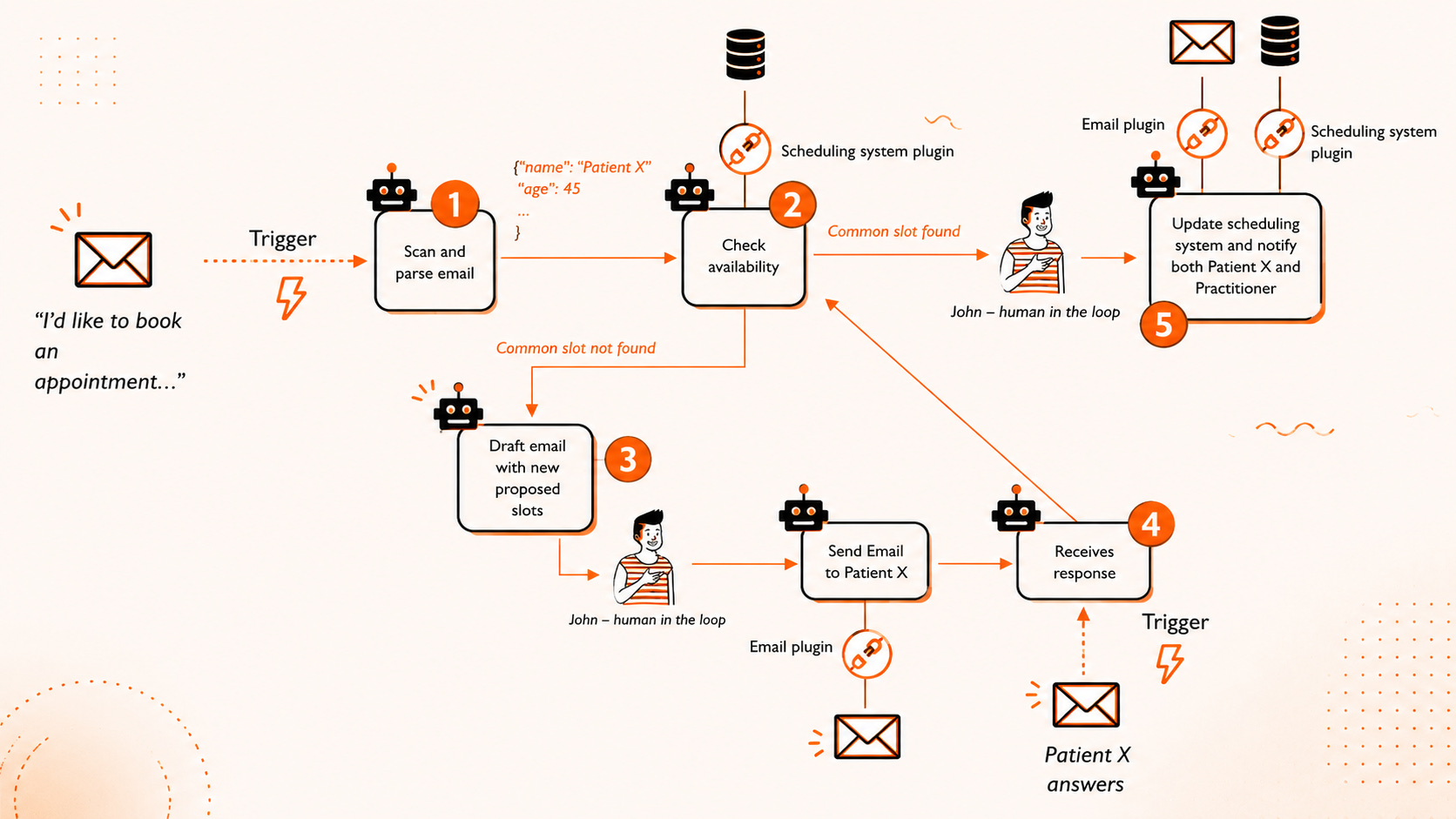
The AI agent automatically scans the email received from Patient X. It extracts key details like the Patient’s name and contact details, preferred date and time, and the specialist practitioner required.
The AI agent checks the availability, invoking the plugin (the tool we equip our agent with) in the clinic’s scheduling system. It matches Patient X’s preferences with the earliest available slots for the specialist practitioner. If there’s a match, it proceeds to Step 5.
The AI agent finds no match. Since no match is found, the AI agent generates a list of the next best available slots based on the specialist’s schedule. It also drafts a response email to Patient X, leveraging a writing skill, with suggested alternatives, but John reviews and approves it before sending.
Patient X responds with a new preference and either:
Accepts one of them and proceeds to Step 5
Requests new options, then the AI agent repeats Step 3
Once John and Patient X agree on a slot, the AI agent automatically schedules the appointment in the system, leveraging the same plugin as above. Plus, it sends a confirmation email to Patient X with the details, leveraging an email plugin. Finally, it updates the specialist’s calendar and notifies them of the booking.
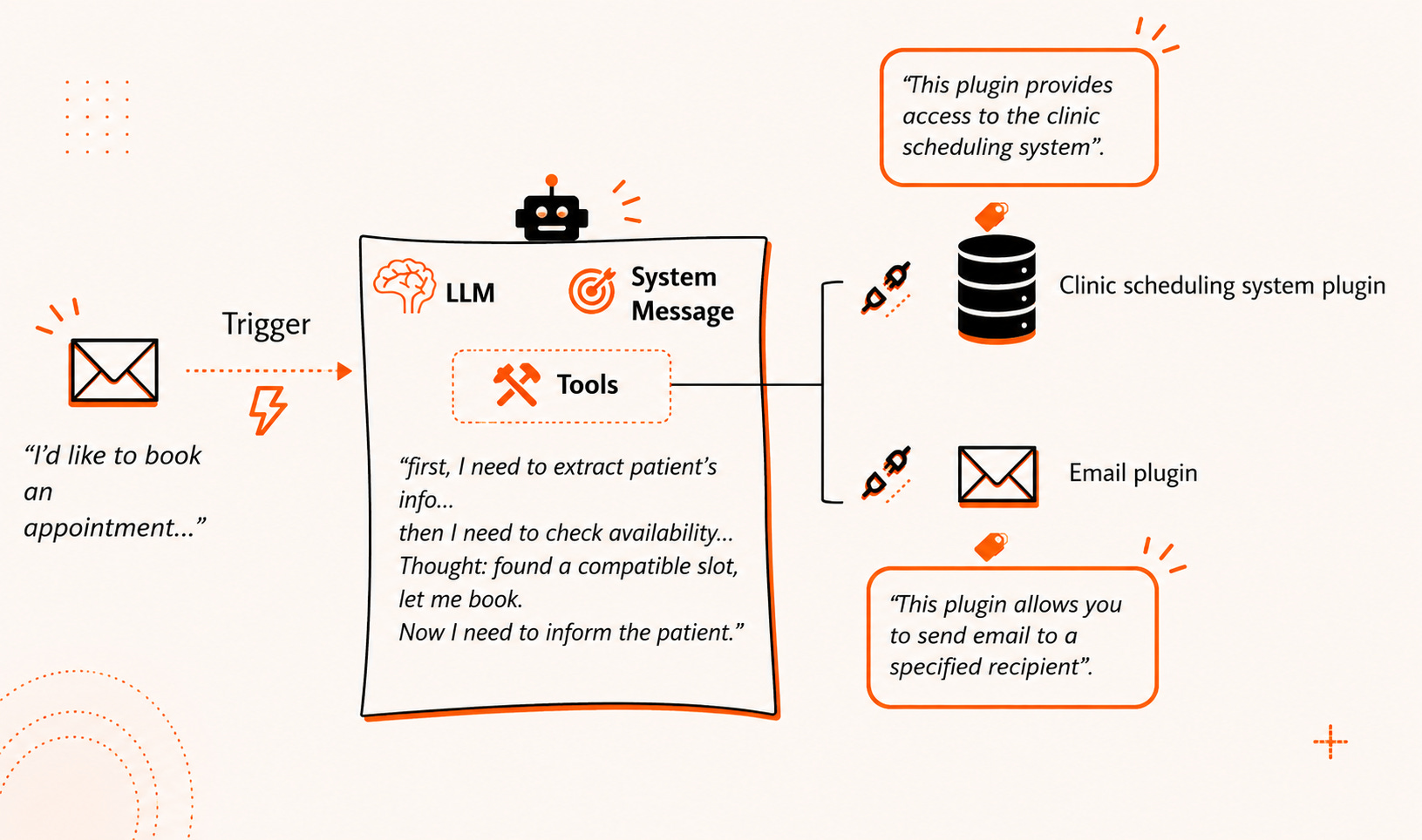
As you can see, the AI agent acts as John’s assistant, handling repetitive scheduling tasks while he focuses on in-person patient interactions.
Autonomous agents
Autonomous agents represent the most advanced category of AI agents. Unlike retrieval and task agents, which operate within predefined boundaries, autonomous agents strategically orchestrate multiple tasks and retrieval processes, making real-time decisions to optimize workflows. These agents exhibit a high degree of independence, adaptability, and contextual awareness, allowing them to perform complex operations with minimal human intervention.
The core distinction of autonomous agents lies in their ability to:
Combine retrieval and action: They can both find information (like a retrieval agent) and act on it (like a task agent).
Plan and self-adjust: They dynamically adapt based on new information or changing constraints.
Perform multi-step workflows: They break down complex tasks into subtasks, execute them iteratively, and adjust based on results. Let’s continue with John’s clinic example. As the clinic gets busier, managing appointments, cancellations, and reschedules becomes overwhelming. A task agent helped streamline individual actions, but now an autonomous agent takes over the end-to-end scheduling process with minimal supervision. Here is how it works, step by step:
Intake and prioritization: The agent monitors all channels (email, portal, phone transcripts), extracts patient preferences, urgency, and specialist needs, and ranks requests based on priority. For example, a canceled appointment opens a slot, and the agent immediately matches it to Patient X, who’s been waiting for a similar time.
Planning and optimization: It reviews the full daily schedule, identifies conflicts or idle gaps, and builds an optimized plan—shuffling low-priority visits to make room for urgent ones.
Execution with feedback: The agent messages patients with options, updates calendars, books appointments, and sends confirmations—all automatically. If preferences change, it loops back, refining its actions.
Real-time adaptation: A doctor calls in sick. The agent halts new bookings, reschedules affected patients, and notifies staff—handling all steps autonomously unless human input is needed.
Continuous learning: At day’s end, it analyzes outcomes, updates patient preferences, and adjusts future prioritization logic.
The autonomous agent can plan, retrieve, decide, act, adapt, and learn—all without relying on predefined workflows. John now focuses on edge cases, while the agent intelligently handles the rest.
Autonomous agents represent the next step in AI-driven process automation. By merging retrieval AI capabilities (context awareness, real-time query refinement) with task execution skills (appointment scheduling, automated notifications), autonomous agents can fundamentally reshape business processes and daily operations.
Even if autonomous agents resonate very well with the concept of business process automation, keep in mind that they can also represent a new enhancement for customer experience. For example, in the scenario above, rather than calling or sending an email, Patient X could leverage the AI agent's conversational UI (via the clinic website or WhatsApp channel). By doing so, Patient X will experience a new, smoother way of interacting with the clinic, while the AI agent captures intent, asks more questions if further information is needed, and orchestrates the backend to execute its tasks.
There are different degrees of autonomy we can provide our agents with, and the decision is based upon the business scenario as well as the level of confidence we have in the accuracy of the solution.
This piece borrows from AI Agents in Practice by Valentina Alto, which I found myself bookmarking constantly while working through these recent pieces on agents.
What stayed with me most wasn’t just the frameworks or implementation details, but how clearly it separates systems that retrieve, systems that execute, and systems that can independently coordinate decisions across workflows. That sounds obvious when written out plainly, yet a surprising amount of the current ecosystem still collapses all three into the same conversation. The more separated those ideas become, the easier it gets to reason about what these systems are capable of doing.