

#3: The illusion of autonomous agents (part 1)
Denis Rothman on why reliability doesn’t emerge on its own
The AI community is caught in a contradiction. On one hand, there is a push to deploy autonomous agents into enterprise environments, expecting them to reason, plan, and execute complex, multi-step workflows. On the other hand, the methodology relied upon to build these agents is overwhelmingly based on prompt engineering, which is merely an attempt to cajole predictable, deterministic behavior out of fundamentally stochastic, black-box LLMs.
This creates a pervasive dissonance: the expectation of industrial reliability built atop probabilistic generation.
The current noise suggests that if we simply scale the parameters, refine the system prompts, or throw more compute at the problem, true autonomous reasoning will spontaneously emerge.
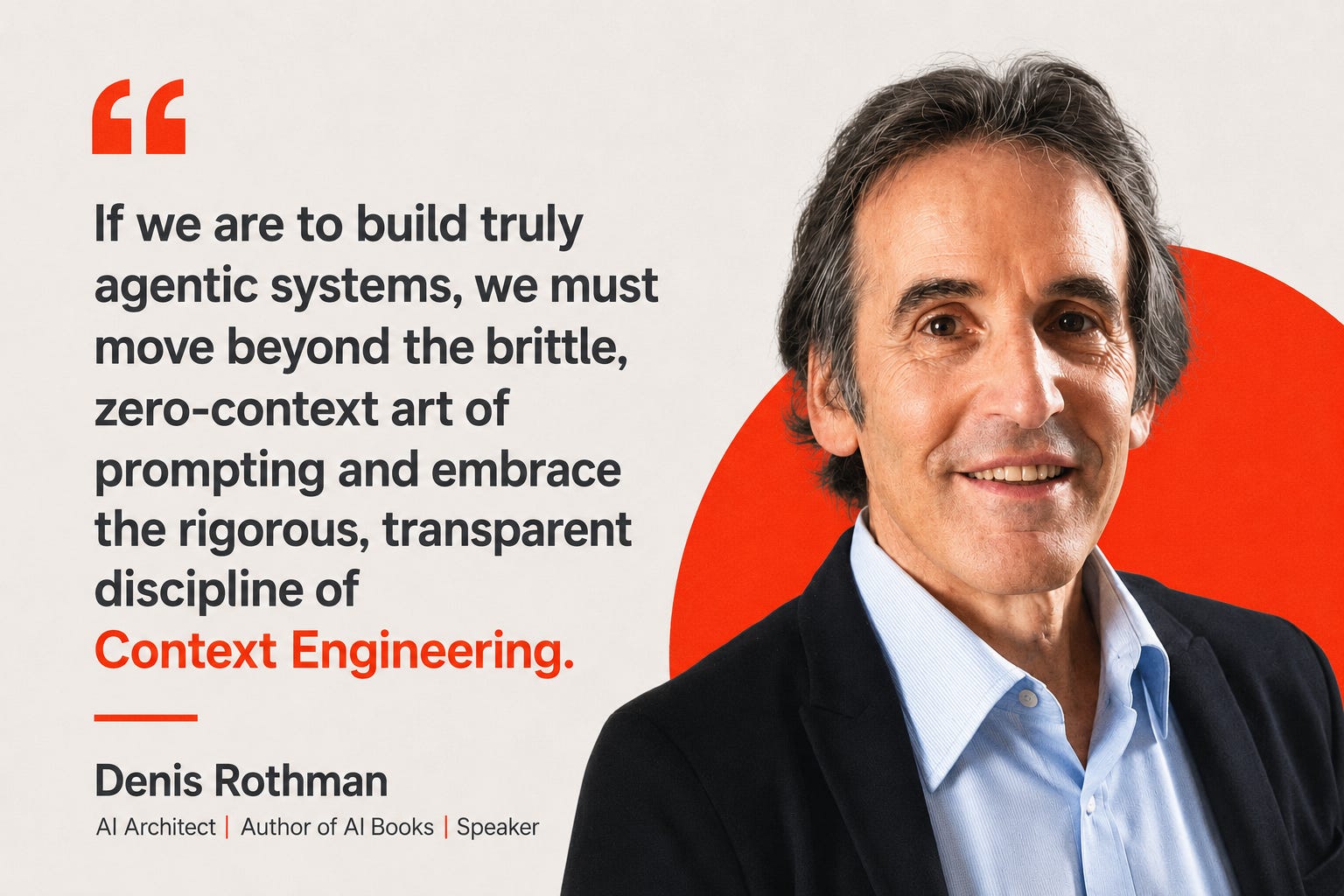
To cut through this noise, we must confront an uncomfortable reality. Unconstrained probabilistic generation cannot serve as the kinematics for reliable robotic or enterprise execution. If we are to build truly agentic systems, we must move beyond the brittle, zero-context art of prompting and embrace the rigorous, transparent discipline of context engineering.
The limits of the translation lattice
At their core, LLMs do not guarantee structured reasoning across steps. They act as translation lattices operating on lossy text compressions, fundamentally disconnected from the non-verbal, experiential grounding that characterizes human thought. They are magnificent at semantic association but possess no innate understanding of physical or logical bounds. When an agent relies solely on an LLM’s internal weights to reason, it runs headfirst into the reality of the Probability Decay Theorem (PDT), a multiplicative reliability collapse effect. The theorem was derived through multiple real-world implementations by the author.
The PDT governs the multiplicative collapse of chained rules. In single-turn interactions, an LLM might succeed 95% of the time. But in agentic workflows requiring multi-step execution, the probability of success does not simply carry an additive exception load PDT1. Instead, it collapses under multiplicative chained probability PDT2. A chain of ten probabilistic bets, each with a 95% success rate, yields an overall reliability that is entirely unacceptable for real-world enterprise operations.
If an autonomous agent executes a sequence of tasks where each step is 95% reliable, the multiplicative collapse of the Probability Decay Theorem dictates that it takes just 14 consecutive steps 0.9514 ≈ 0.488 for the overall success rate to plummet below 50%, rendering the entire workflow less predictable than a blind coin toss. This shows that after enough chained steps, reliability rapidly degrades below usable thresholds, even when individual steps appear highly accurate.
LLMs operate on statistical associations in text without explicit grounding in physical or logical constraints. This means that mapping raw signals to lexical labels will always incur an irreducible loss due to the polysemy inherent in language. These models are structurally bounded by the imprecision of polysemy. Treating their hallucinations as mere software bugs to be patched by longer text prompts ignores the mathematical reality of the medium.
The embodied reality factor
To understand how to fix this, we must look at the lineage of modern embodied AI, tracing back to industrial automated systems. Physical robotics and real-world supply chains cannot operate on unconstrained probabilistic generation. Instead, algorithmic logic must be ruthlessly translated into the thermodynamic and spatial kinematics of the physical world. This absolute reliance on physical bounds forms the applied foundation for defining hard limitations such as spatial collisions, reaction times, and hardware constraints, which are not errors. They are the foundational constraint forces that dictate the accuracy of a signal. This principle inherently solves the simulation-to-reality (Sim2Real) transfer gap. If we want our digital agents to interact reliably with the real world, we must enforce digital representations of physical limits to ensure their reasoning remains strictly bounded by the reality factor of the environment.
If reliability cannot emerge from probabilistic generation alone, then it has to come from somewhere else. That somewhere else isn’t another prompt. It’s context, engineered as a first-class component of the system.
That’s where we’ll begin in Part 2. See you next Thursday!
Denis Rothman graduated from Sorbonne University and Paris-Diderot University, designing one of the very first word2matrix patented embedding and patented AI conversational agents. He began his career authoring one of the first AI cognitive NLP chatbots applied as an automated language teacher for Moet et Chandon and other companies. He authored an AI resource optimizer for IBM and apparel producers. He then authored an Advanced Planning and Scheduling (APS) solution used worldwide.