

#4: The illusion of autonomous agents (part 2)
Denis Rothman on context engineering as the missing layer for reliable AI agents
Last week, we explored why autonomous agents struggle to deliver the reliability enterprises expect. The problem isn’t simply that LLMs make mistakes, but that prompt engineering alone cannot overcome the structural limits of probabilistic reasoning. If reliability cannot emerge from prompts, then it must be engineered elsewhere. That “elsewhere” is context: not as a longer system prompt or larger context window, but as a structured, transparent architecture that guides how agents reason, communicate, and act. This is where context engineering begins.
Context complexity exists across five distinct levels, evolving from zero-context basic prompts to highly advanced semantic blueprints. Prompt engineering resides at the shallowest level, treating context as a mere text prefix. Context engineering, conversely, treats context as a structural, programmatic architecture.
To build a robust multi-agent system (MAS), we must transition from linear text parsing to multidimensional semantic structures. We can achieve this by implementing Semantic Role Labeling (SRL) to map complex data relationships natively. By utilizing the Model Context Protocol (MCP), we can define rigorous protocol message formats that specialist agents such as a Researcher, Writer, and Orchestrator use to communicate without ambiguity.
Instead of hoping a black-box model infers the correct workflow, we architect a semantic blueprint that explicitly guides the system’s reasoning process, completely decoupling the immutable enterprise data layer from the probabilistic reasoning layer.
Architecting the glass-box context engine
The antidote to black-box unpredictability is the context engine: a transparent, glass-box architecture of context and reasoning. In this framework, the engine’s core intelligence is compartmentalized into distinct, observable modules: the Planner, the Executor, and the Tracer.
The Planner: Acts as a meta-controller. It utilizes a discoverable Agent Registry to dynamically route tasks, intelligently switching between semantic search and strict data filtering based on the precise context of the request.
The Executor: Relies on a Dual RAG architecture, simultaneously processing factual data via a strict Knowledge Base and procedural instructions via a Context Library.
The Tracer: Allows human operators to parse the ExecutionTrace object to render token metrics, dependency resolutions, and view the internal “thinking” steps of the agent.
Within a finite reaction field, agent decisions must be bounded by plausibility to avoid cognitive dissonance. We enforce these boundaries using operators like the Semantic Switch ($\sigma$) and the Triton Planner Kernel. These tools apply explicit, rule-bound kinematics over the continuous probabilities of the neural field, acting as the constraint satisfaction engines that pure LLMs lack.
Enterprise guardrails: Scaling with Dual RAG
Bringing these systems into production requires moving AI directly to the data. By leveraging architectures of modern enterprise databases with vector and relational support, we can build Sovereign AI systems that are dock-agnostic, portable multi-agent systems directly to immutable enterprise databases.
This paradigm shift enables hyper-contextual capabilities:
Hybrid querying: Combining strict SQL scalar filters (such as experience levels or salary caps) with semantic vector searches to generate grounded, policy-compliant recommendations.
Converged Spatial-RAG and GraphRAG: Integrating physical geolocation (Oracle Spatial) and social dimensions (SQL Property Graphs) directly into the vector search pipeline to evaluate meaning, physical proximity, and relationship mappings simultaneously.
Micro-context engineering: Deploying specific Summarizer agents to proactively manage API costs, reduce context overhead, and actively manage token limits.
Policy-driven moderation: Implementing a two-stage moderation gatekeeper that flags anomalies, prevents data poisoning, and adapts to real-world legal compliance limits.
Conclusion: From cost center to value multiplier
The debate over how to achieve true agentic reasoning will not be settled by building ever-larger black boxes or writing increasingly convoluted text prompts. The future belongs to those who recognize and engineer around the structural boundaries of artificial intelligence.
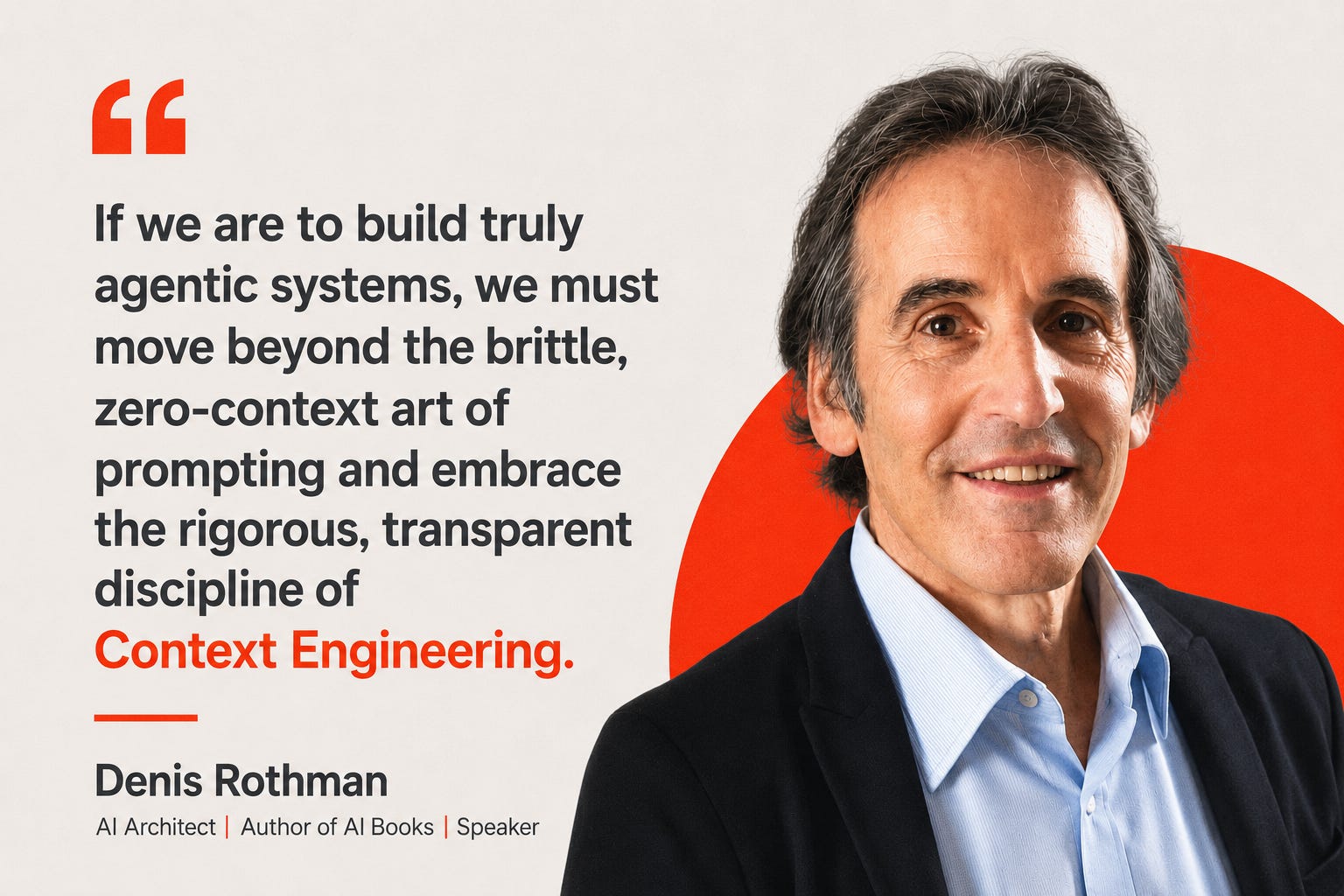
By embracing context engineering, we shift AI from an unpredictable stochastic experiment into a verifiable, transparent asset. Through glass-box architectures, Dual RAG pipelines, and the rigorous application of spatial and semantic boundaries, we can finally build human-centered AI systems that are genuinely business-ready. It is time to stop prompting the machine and start engineering the context.
Denis Rothman graduated from Sorbonne University and Paris-Diderot University, designing one of the very first word2matrix patented embedding and patented AI conversational agents. He began his career authoring one of the first AI cognitive NLP chatbots applied as an automated language teacher for Moet et Chandon and other companies. He authored an AI resource optimizer for IBM and apparel producers. He then authored an Advanced Planning and Scheduling (APS) solution used worldwide.
Less hype, more engineering. Pull up a chair.